Hiring Process & Evaluation and Compensation System
Core Principles of Our Evaluation System
We aim to engage with every candidate with the same level of sincerity and standards we hold for our own team. That’s why we openly share how our evaluation and compensation systems work. On this page, we outline our evaluation framework, “HELIX,” and explain how offers are determined based on it.
Maximizing Growth and Impact
We support each individual in growing and taking on larger, more meaningful missions.
Full Alignment
Evaluation and compensation are fully aligned. Once an evaluation is determined, compensation is automatically set based on it.
Held to the same standards as our Team members
The same evaluation criteria used for current team members are applied throughout the hiring process. This ensures there are no gaps in expectations or perceptions of fairness after joining.
Adaptability to Change
As a rapidly growing startup, our systems will continue to evolve. The details outlined here reflect our current approach.
Evaluation Framework (Two Axes)
Evaluation is based on two axes: “Expected Role (Job Level)” and “Capability Assessment (Competency).”
While advancing to a higher job level takes time, capabilities grow steadily through day-to-day work. To ensure that this progression is properly reflected in both evaluation and compensation, we adopt this two-axis framework.
In the hiring process, evaluations are not based on the role we expect you to grow into after one year, but on the role you can take on immediately upon joining—grounded in proven, reproducible performance.
Expected Role (Overall Level: Grade 1– 5)
This represents the scope and scale of the mission expected by the company. From Grade 3 onward, the career track branches into either IC (Individual Contributor) or EM (Engineering Manager).
Horizontal Axis: Capability Assessment (Competency)
This represents the individual skills and behavioral traits as an engineer or designer.
Capability is evaluated across five categories. Rather than focusing on what you know, the assessment is based on demonstrated actions—evaluated through concrete, fact-based evidence of how those capabilities are applied in practice.
Hard Skills (Execution Capability)
Detailed Evaluation Criteria (Sub-indicators)
Each competency is assessed not only by grade, but also through detailed sub-indicators (e.g., 3-1, 3-2) that measure the level at which it is demonstrated.
Throughout the hiring process, including technical assignments and interviews, we evaluate competencies at this level of granularity.
Compensation Mechanism
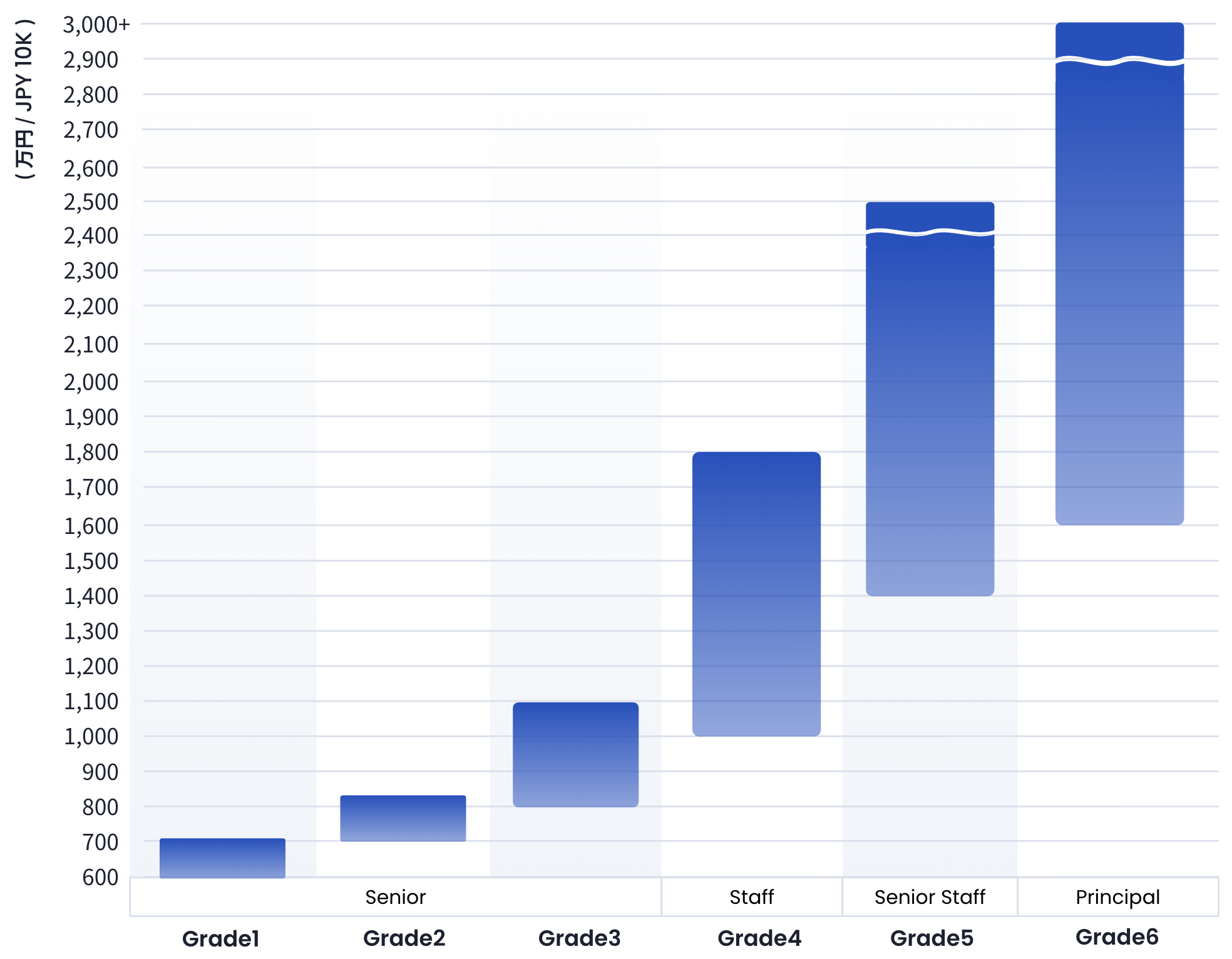
CADDi’s compensation system is designed with high transparency: once an evaluation is determined, the corresponding compensation is automatically set.
How Compensation Is Calculated
Compensation is determined by the sum”of the following elements:
Once the overall grade is determined, the total compensation is set.
On top of that, additional amounts are added based on the evaluation results for each of the five competencies.
The weight (amount) for each competency varies.
Key Policy
This reflects our firm commitment to fairness: we want an organization where those who demonstrate skill and deliver results are rightfully rewarded, rather than those who are simply the loudest.
Salary Table
Performance evaluations are conducted twice a year, every six months
Stock option program available
During the offer meeting, we will explain in detail how we have evaluated your experience based on this framework, as well as our expectations for your role and contributions at CADDi.
If you have any questions or concerns, please feel free to ask them during the meeting.
CV Screening
The experience and skills you provide in your application will be used as a basis for deeper discussion in subsequent interviews.
For this reason, we will share the key points we would like you to include in advance. By having candidates address these points in their documents, we aim to prevent early mismatches and avoid rejections due to incomplete information.
Information we would like you to include
Skills Summary
First, we will confirm whether you meet the qualifications listed in the Job Description. If possible, please provide a summary of your experience and skills. When listing skills such as programming languages or frameworks, it is especially helpful to include your years of experience alongside each.
Work Experience
From your work history, we aim to understand not only the projects you have worked on as a Software Engineer or Product Designer, but also the challenges you faced and how you addressed them. Therefore, in addition to describing each project, please include the following details:
Project Overview – A brief summary of the project.
Your Role – How you contributed to the project.
Technical Challenges – The technical obstacles you encountered and how you tackled them.
Results and Impact – The outcomes of your work and the value it created.
Coding Test
For some positions, we ask candidates to take a coding test.
This guideline explains the key points we evaluate in the coding test, as well as common questions we receive.
What We Look for in the Coding Test
We place more emphasis on whether your code gives the sense that we could imagine collaborating with you on development, rather than on algorithm knowledge or speed.
In addition to correctly passing a certain proportion of test cases, we also assess code quality, including readability. We encourage you to approach the test with the mindset of “Would I want to work with the person who wrote this code?”
FAQ
Working Style
FAQ
Open Positions
About CADDi